

TourXpeRience Project Highlights Growing Role of XR in Tourism Education
TourXpeRience Project Highlights Growing Role of XR in Tourism Education
TourXpeRience Project Highlights Growing Role of XR in Tourism Education
https://www.wittenborg.eu/tourxperience-project-highlights-growing-role-xr-tourism-education.htm
Panel Discussion and Teacher Training Highlight How XR Can Enhance Tourism Education
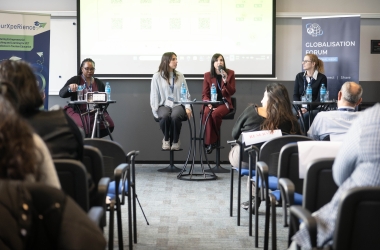
How can virtual reality help students prepare for the workplace? That question was at the centre of discussions during Wittenborg's Globalisation Forum and International Week, where educators and project partners involved in the Erasmus+ TourXpeRience project explored how Extended Reality (XR) technologies can support tourism education.
The discussion brought together partners from across Europe to share insights from the project, which aims to help educators integrate Virtual Reality (VR), Augmented Reality (AR) and Mixed Reality (MR) into teaching and learning.
The panel was led by Vajihe Shojaei and featured Emmah Muchoki and Vanessa de Oliveira Menezes from Wittenborg, alongside Stefania Bertolazzi from CEIPES ETS in Italy and Mariola Chrzanowska from Warsaw University of Life Sciences in Poland.
From whiteboards to immersive learning
For De Oliveira Menezes, one of the most interesting aspects of the project has been seeing how educational tools continue to evolve.
“Things are changing very fast. We did not always have projectors, whiteboards or green boards. Technology is improving every day and part of that technology is being applied in education,” she said.
“I was always fascinated by this kind of innovation. When I heard about the possibility of applying these tools as a lecturer, I did not know much about them. For me, it was rewarding to learn more about their potential and how to create scenarios.”
Through the TourXpeRience project, educators have explored how immersive scenarios can be used to recreate situations students may encounter in the tourism industry.
According to De Oliveira Menezes, these experiences allow students to develop practical skills in a setting that goes beyond traditional classroom teaching.
“This technology is not just about having fun. You learn from it and develop specific skills. Students need to learn how to make decisions and how to handle certain situations in the workplace.”
Her comments reflected one of the key themes of the discussion: helping students learn by doing rather than simply learning through lectures or presentations.
Muchoki, who trains teachers within the project, made the same point with a joke she often uses in her pedagogical training sessions: traditional teaching can amount to “death by PowerPoint”.
“Master’s students can have a six-hour class with more than a hundred slides. We feed students so much information that they barely have time to process it,” she said. “With XR, we can shift the classroom from slide after slide to a scenario where students make decisions point by point. That is much more engaging and much more meaningful for them.”
Beyond the technology
Throughout the session, speakers emphasised that the TourXpeRience project is not simply about introducing new technology into classrooms.
“XR is not the only objective here. We have a much wider goal, which is using these technologies in the classroom where teachers can help students better,” said Shojaei.
The panel introduced the TourXpeRience e-learning platform and discussed how the project is helping educators understand both the practical and pedagogical value of immersive learning.
Partners are currently developing 26 XR-based learning activities focused on the tourism sector.
While the project has initially concentrated on supporting teachers, future phases will increasingly focus on students and the implementation of these activities in educational settings.
The panellists also discussed how each partner institution is contributing to the project at national level while working towards a shared European approach to innovation in tourism education.
Muchoki explained that XR works best when it is built into the structure of a lesson: the teacher first introduces the concept, students then complete the XR exercise and finally they reflect on what they have experienced.
“What we want to do is reduce the abstractness of concept learning, especially in tourism education,” she said.
Preparing educators for future classrooms
The discussion acknowledged that some educators remain hesitant about adopting emerging technologies. However, speakers argued that understanding these tools is becoming increasingly important as digital technologies continue to reshape both education and industry.
Several panellists noted that, while Artificial Intelligence currently dominates discussions around educational technology, XR is expected to become increasingly common in education and professional training. They argued that immersive learning environments offer opportunities for students to practise decision-making and problem-solving in ways that are difficult to achieve through traditional classroom teaching alone.
Confidence, assessment and curriculum
Students in the audience joined the discussion too. When one asked whether practising in VR really helps if you know the situation is not real, Muchoki said the value lies in building confidence.
“One of the main reasons we want to introduce this in teaching and learning is to create a safe environment where students are free to make their own decisions, first in the classroom,” she said. “You may still be nervous in the real situation, but it is no longer the first time you have to do it.”
On assessment, Muchoki suggested that a VR scenario could count towards part of a module grade, to encourage students to engage more critically, while noting that a single scenario is unlikely to test all of a module’s learning aims.
Asked what is needed for XR to become valuable in higher education, she pointed to the curriculum.
“We need to revisit our curricula to see how we can incorporate these technologies. AI is quickly taking over the curriculum, but the use of technology like this is still lagging behind.”
From discussion to practice
The panel discussion was followed by a hands-on teacher training session on 4 November, giving participants the opportunity to experience some of the Virtual Reality applications developed through the TourXpeRience project.
According to Shojaei, the training used a mix of tourism-related and cross-disciplinary examples so that teachers could see how XR scenario design can be applied beyond one subject area.
Examples ranged from handling an unhappy hotel guest and practising front-desk communication to responding to a travel disruption in which a flight change affects transfers, hotel arrival and planned activities. Others covered negotiation, marketing situations such as a campaign problem or reputational issue, and team disagreements in which learners have to justify their position, explore alternatives or find a compromise.
Teachers also worked on branching scenarios, in which learners choose between different realistic responses, for example how to communicate with a frustrated customer, and then see how their choice affects trust, the customer’s reaction and the next stage of the scenario. In one activity, participants chose a real challenge from their own teaching and turned it into an interactive learning scenario, defining the learner’s role, the setting, the trigger, the decision points, possible responses, consequences and feedback.
“The main focus was not simply on using a headset, but on designing realistic situations in which students can practise decision-making, communication, problem-solving and professional judgement in a safe environment,” said Shojaei.
WUP 23/11/2026
by Erene Roux
©WUAS Press
Tags
#Erasmus+
#research
#ResearchCentre
#Internationalisation
#GRT7: Future of Work
#SDG8: Decent Work and Economic Growth
1160 words