

Wittenborg Students Gain Practical Roadmap to Enter the Dutch Job Market
Wittenborg Students Gain Practical Roadmap to Enter the Dutch Job Market
Wittenborg Students Gain Practical Roadmap to Enter the Dutch Job Market
https://www.wittenborg.eu/wittenborg-students-gain-practical-roadmap-enter-dutch-job-market.htm
Workshop Equips International Graduates With Career, Networking and Employment Strategies
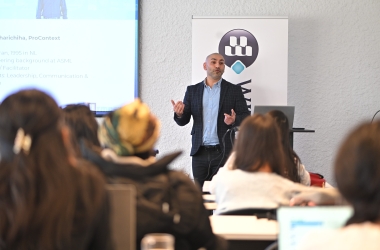
Wittenborg welcomed Nima Sagharichiha, founder of ProContext Expat Academy, to the Apeldoorn Campus for a four-hour interactive workshop designed to help international students prepare for their first job in the Netherlands after graduation.
Titled Launch Your Career with Confidence, the session guided final-year bachelor's students and master's students through a practical five-step framework covering career direction, networking, personal branding, interviewing and employment regulations.
Throughout the workshop, students were encouraged to view their job search as a strategic project rather than a matter of chance.
“Finding a job in a new country is a project, not luck. Today you build the plan,” Sagharichiha told participants.
Finding direction before applying
The workshop began with a focus on helping students identify their career goals and understand where their skills align with labour market demand.
Sagharichiha encouraged students to reflect on their strengths, the problems they can solve and the sectors that match their interests and experience. He argued that having a clear target role and industry is more effective than sending large numbers of unfocused applications.
“One clear direction is stronger than 50 random applications,” he said.
Students explored industries where international graduates are frequently recruited, including IT and data, finance, engineering, energy, logistics and hospitality.
Reflecting on the challenges international students face, Sagharichiha later explained that many graduates struggle not because they lack skills, but because they struggle to communicate the value they can bring to employers.
“Many international students have great skills but struggle to communicate their value,” he said. “They often focus on listing their qualifications rather than explaining how their experience can help a company solve a specific problem.”
Networking the Dutch way
The second part of the workshop focused on networking and relationship building, with students learning how professional contacts often lead to opportunities before vacancies appear on job boards.
Sagharichiha introduced participants to what he described as "lifelines", including alumni, lecturers, former internship supervisors, recruiters and professional networks.
Rather than immediately asking for employment, students were encouraged to seek advice, information and connections.
“Don't start by asking for a job,” he said. “Start by building genuine relationships.”
Participants also practised developing a concise 60-second professional pitch and learned how to approach professionals on LinkedIn with personalised and respectful messages.
Building a strong personal profile
A significant portion of the workshop was dedicated to helping students improve their CVs, cover letters and LinkedIn profiles.
Sagharichiha explained the characteristics of a Dutch-style CV, including concise formatting, measurable achievements and clear information about residence permit status.
Students were encouraged to focus on results rather than responsibilities and to demonstrate impact through evidence and data wherever possible.
The workshop also highlighted the importance of tailoring applications to specific opportunities.
“Finding a job is not just about sending applications,” Sagharichiha said. “It's about having a clear strategy, understanding your strengths, targeting the right opportunities and taking consistent action.”
Understanding Dutch workplace culture
Interview preparation and cultural awareness formed the fourth stage of the programme.
Using the STAR method, students practised structuring interview answers around specific situations, tasks, actions and results. The session also explored cultural aspects of working in the Netherlands, including direct communication, flat organisational structures and the importance of initiative.
According to Sagharichiha, Dutch employers often value proactivity, independence, teamwork, communication skills and a willingness to learn.
“Dutch employers appreciate people who take the initiative and speak up,” he said. “During a meeting, don't just listen and agree. Ask a thoughtful question, share an idea or suggest an improvement. This demonstrates confidence and engagement.”
Navigating contracts, salaries and residence permits
he final section focused on practical aspects of employment, including salary expectations, contract terms and immigration regulations.
Students received an overview of the transition from the orientation year residence permit to the highly skilled migrant route, as well as guidance on understanding employment contracts and approaching salary negotiations professionally.
Sagharichiha stressed the importance of researching salary ranges and evaluating employment packages as a whole, including training opportunities, travel allowances and hybrid working arrangements.
Supporting students beyond graduation
Following the workshop, Sagharichiha praised the level of engagement shown by participants.
“I really enjoyed the workshop and was impressed by the interest, engagement and thoughtful questions from the students,” he said. “It clearly showed how relevant this topic is for international students preparing to enter the Dutch job market.”
He also encouraged students to begin career preparation well before graduation.
“Don't wait until graduation to build your network,” he said. “Attend industry events, connect with professionals on LinkedIn and arrange informal conversations with people working in your target field.”
Sagharichiha concluded by reminding students that their international backgrounds should be viewed as a strength rather than a limitation.
“Focus on what you can offer rather than what you lack. Your international background can be a real strength if you know how to present it.”
Students interested in further support were invited to contact ProContext for a free introductory career conversation and personalised guidance tailored to their career ambitions and circumstances.
WUP 28/10/2026
by Erene Roux
©WUAS Press
Tags
#SDG8: Decent Work and Economic Growth
#Internationalisation
#internationalstudent
#apeldoorn
#highered
868 words