

Wittenborg Student Explores Diversity and Inclusion in the Event Industry
Wittenborg Student Explores Diversity and Inclusion in the Event Industry
Wittenborg Student Explores Diversity and Inclusion in the Event Industry
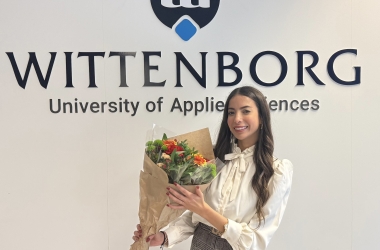
Maryame Hakimi Investigates How Festivals Can Create Welcoming Experience for International Audiences
https://www.wittenborg.eu/wittenborg-student-explores-diversity-and-inclusion-event-industry.htm
How can international festivals make every visitor feel truly welcome?
That question inspired Wittenborg graduate Maryame Hakimi to explore how Diversity, Equity and Inclusion (DEI) strategies shape audience experiences in the event industry. For her MBM in the Events Industry, she focused her thesis research on the Het Vrije Westen Liberation Festival, a celebration of freedom and cultural diversity.
“This topic is relevant because Diversity, Equity and Inclusion are becoming essential in today’s event industry, where audiences are increasingly international,” Maryame explains. “Festivals can either create a strong sense of belonging or unintentionally exclude people, so understanding how DEI strategies affect attendees is important. I wanted to explore how events like Het Vrije Westen can make everyone feel welcome and represented.”
Maryame employed a qualitative research method, conducting semi-structured interviews with 12 international attendees. “This approach allowed me to explore their personal experiences and perceptions of DEI in depth. I also conducted a literature review to connect my findings to existing research on inclusion in the event industry,” she says.
The participants, representing various cultural backgrounds, were reached through flyers distributed at the festival, which linked to a webpage Maryame created to explain the study and facilitate scheduling. The interviews covered topics ranging from feelings of welcome and cultural representation to language accessibility, staff approachability and opportunities for intercultural interaction.
Through her research, Maryame identified three key themes. First, experiential inclusivity, where attendees valued practical signs of inclusion such as multilingual signage, accessible spaces and friendly, open-minded staff. Second, emotional belonging and representation, which highlighted the importance of seeing one’s culture reflected in music, food and the festival atmosphere. Finally, she found barriers to inclusion like limited translation options, accessibility challenges and payment systems that were not always inclusive. “Overall, these themes show that inclusion works best when it’s visible, consistent and embedded in every detail of the event experience,” she highlights.
Reflecting on her project, Maryame shares that what she enjoyed most was hearing real stories from international attendees. “It was fascinating to see how differently people experienced the same event depending on their background and expectations. Those insights helped me understand how inclusion actually feels in practice, not just as a concept.”
Looking ahead, the graduate hopes to apply her findings in the professional arena. “I’d like to work for a major event company where I can design events that are more diverse, equitable and inclusive for international audiences. I also plan to expand my research by including other perspectives, especially from event organisers, to understand how DEI strategies are developed behind the scenes.”
She also offers advice to future Wittenborg students undertaking their final projects: “Understand the structure and expectations of your project before starting. Connect your research to something practical that could have real value beyond the classroom. Be proactive in communicating with your supervisor and focus on producing work you’re proud of; it reflects your growth throughout the programme.”
Maryame’s project also reinforced her passion for creating inclusive experiences. “Doing this research helped me grow academically and personally, and confirmed that I want to keep working in this field to make events more welcoming for everyone,” she concludes.
WUP 18/08/2026
by Ulisses Sawczuk
©WUAS Press
568 words