

From VR Classrooms to AI Education: Research Centre Shares Latest Developments
From VR Classrooms to AI Education: Research Centre Shares Latest Developments
From VR Classrooms to AI Education: Research Centre Shares Latest Developments
https://www.wittenborg.eu/vr-classrooms-ai-education-research-centre-shares-latest-developments.htm
Meeting Highlights Growing Impact of International Projects and Partnerships
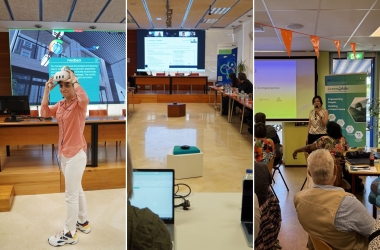
Artificial intelligence, immersive learning and sustainability were among the key themes discussed during Wittenborg’s Research Centre meeting on 23 June, where colleagues shared updates on international projects, research developments and upcoming opportunities.
The meeting opened with a welcome from Jian Liu and an introduction to Davide Parrilli, who recently joined Wittenborg as a lecturer. Parrilli shared his research background in design ethics, service design and data protection, including previous research experience during his PhD in Portugal and postdoctoral work at the Technical University of Delft.
TourXpeRience: Bringing VR and XR into the Classroom
Vajihe Shojaei, Assistant Professor of Applied Sciences, provided an update on the Erasmus+ TourXpeRience project, which focuses on introducing virtual reality (VR), augmented reality (AR) and extended reality (XR) technologies into education.
The project is now preparing a teacher training programme planned for September and October 2026. The training aims to help educators understand how immersive technologies can be used to create new learning experiences for students.
“The goal of this training is not just to teach teachers how to work with the technology,” Shojaei explained. “More importantly, it is how to provide a better learning experience to students by designing scenarios and using this technology in classrooms.”
The blended programme will include online and on-campus sessions, practical activities with VR equipment and training on the project’s e-learning platform. Teachers will also learn how to design educational scenarios that can be adapted for their own modules.
Within the project, partners have already developed 24 VR and XR scenarios. One example presented during the meeting involved a travel agency booking disruption, where students take on professional roles, make decisions and receive feedback based on their choices.
The project team is also preparing a panel discussion on VR technologies, education and hospitality learning as part of the Globalisation Forum 2026.
Green4ADU: Moving Towards Final Recommendations
Cha-Hsuan Liu, Associate Professor of Applied Sciences, shared the latest developments from the Green4ADU project, which is now entering its final phase.
The Erasmus+ project focuses on developing green learning pathways and improving opportunities for adult learners. Current activities are focused on recommendations for stakeholders, including policymakers, based on research, workshops and discussions with educators and learners.
A focus group held with adult educators explored approaches to sustainability education and how green skills can become more relevant to learners.
“The focus group told us that teaching sustainability is not only about education itself, but how to make sustainability actionable, relevant and economically meaningful for our target group,” Liu said.
The project also involved Wittenborg students through a project week in May, where around 160 students participated in activities focused on sustainability, green skills and career opportunities. Students joined webinars, workshops and World Café discussions, while also reflecting on experiences from a local job fair.
A workshop in The Hague brought together adult learners for practical sustainability activities, discussions and community engagement.
The project will now continue with dissemination activities, recommendations and international events, including a final conference connected to the Globalisation Forum 2026.
AIDEA: Exploring AI in Design Education
Robert Muster, Senior Lecturer, presented an update on AIDEA (Artificial Intelligence for a New Design Education Approach), an Erasmus+ project exploring how artificial intelligence can be integrated into design education.
The project is currently in its first year and has completed a literature review, ecosystem mapping activities and initial focus group research involving teachers, students and design professionals.
“The main idea is to combine design education with AI as a partner, not as a replacement of the human,” Muster explained.
The project research has examined topics including the changing role of designers, AI literacy, sustainability applications and responsible AI use in education.
The focus group discussions highlighted the importance of human judgement and creativity, while also raising questions around access to AI tools and the possibility of a future “AI divide”.
Future activities include further development of educational approaches, international exhibitions and a pre-incubator where students can develop AI-supported design projects and business ideas.
Research and International Collaboration
Rauf Abdul, Dean, provided updates on accreditation developments, including the recent FIBAA and NVAO panel visit. Abdul encouraged colleagues to continue developing research publications connected with Wittenborg.
The meeting also included an update on the third edition of the Globalisation Forum, taking place on 2 and 3 November 2026.
The programme will include activities connected to Green4ADU and TourXpeRience, alongside keynote talks, panel discussions and networking opportunities.
Mobility Opportunities and Future Projects
Aydan Holtrigter, Head of Research Partnerships and International Mobility, updated colleagues on Erasmus mobility opportunities available for faculty and professional staff during the 2026–2027 academic year.
She encouraged colleagues to use mobility opportunities to develop international connections, explore research collaborations and strengthen partnerships with institutions across Europe.
Holtrigter also shared updates on new project proposals currently being developed, including a large Erasmus+ proposal under the Centres of Vocational Excellence programme. The Research Centre is currently looking for additional Dutch vocational education partners to join the consortium.
WUP 13/07/2026
by Erene Roux
©WUAS Press
Tags
#research
#ResearchCentre
#Erasmus+
#Internationalisation
#internationalstudent
856 words