

Inside Wittenborg’s Alumni Event: Careers in the Age of AI
Inside Wittenborg’s Alumni Event: Careers in the Age of AI
Inside Wittenborg’s Alumni Event: Careers in the Age of AI
https://www.wittenborg.eu/inside-wittenborgs-alumni-event-careers-age-ai.htm
Amsterdam Alumni Event Highlights Shifting Definitions Of Career Success in AI Era
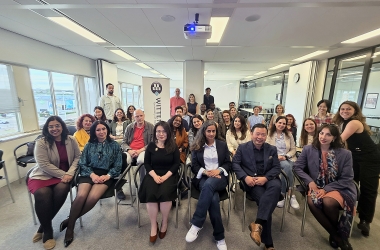
The first Wittenborg alumni event in Amsterdam drew more than 40 graduates, professionals and academics for an afternoon of networking and discussion on how artificial intelligence is reshaping work, careers and ideas of professional success.
Held at the Wittenborg University of Applied Sciences Amsterdam campus on 17 June, the session combined keynote talks and a panel discussion centered on a recurring theme: whether modern careers are best understood as a stable organisational path (“Path A”), an entrepreneurial route (“Path B”), or an increasingly common hybrid of both.
The event opened with Wen Koster, founder of Amstara and a specialist in career transition and Human–AI work design, who argued that AI has fundamentally changed how people must think about career development.
Koster said that before COVID-19 and the rise of AI, many professionals followed linear career trajectories, with alternative paths often treated as optional or secondary. That assumption, she suggested, no longer holds.
“What used to be a luxury question has become a survival question,” Koster said. “You need to be the author of your own book.”
Koster outlined Path A as building value within established systems, and Path B as creating independent systems through entrepreneurship or self-directed work. Increasingly, she argued, professionals are expected to develop both.
She encouraged participants to reflect on their direction through a set of questions: what they value, who they want to become, and how they can test skills through short, structured experiments. She suggested a 21-day trial approach as a way of exploring new competencies before committing long-term.
A panel of alumni then brought the framework into lived experience.
Sadaf Bafandeh, Human Resources and Business Expert at Hitachi, described her career as primarily Path A, focused on organisational development and employee growth.
Bafandeh said organisations are increasingly introducing mandatory AI training as employees adopt tools such as ChatGPT and Copilot, often without sufficient understanding of risk or governance.
“Everyone is using AI tools but they do not have sufficient knowledge,” Bafandeh said. “We need to make sure employees have the right skills to use them safely.”
She added that AI literacy is no longer optional, extending beyond employees to managers and senior leaders, many of whom underestimate the complexity of the systems they are working with.
Somayyeh Nowroozi, Product Quality and Recovery Manager at IKEA Group, described her career as a blend of structure and creativity, combining organisational systems with adaptability.
Nowroozi said mandatory e-learning has become central to her organisation’s approach to skills development, with some training modules repeated every six months and others annually to ensure knowledge remains current across different teams.
She emphasised that large organisations must continuously update learning systems to match changing skill requirements across departments.
Oleg Voronin, Senior Business Intelligence Analyst at Incotec, reflected on how moving to the Netherlands reshaped his professional direction.
Having previously run his own business, Voronin said he initially followed Path B before shifting towards Path A after relocating, using structured employment to rebuild his career in a new country.
“Sometimes following Path A is a very useful instrument when you restart in a new country,” Voronin said. “It helps you understand culture, management styles and how organisations work.”
He added that informal networks often play a decisive role in career development.
“I think Wittenborg should add a course on how to use social activities in the Netherlands as an instrument to find a job,” Voronin joked.
Olawale Olukunga, Recruitment Consultant at Independent Recruiters, described himself as a “clear hybrid”, balancing recruitment work with a long-standing entrepreneurial practice in footwear and accessories design.
Olukunga said his Path A role provides stability, while Path B allows creative freedom and long-term ambition, with pop-up events taking place in Amsterdam and planned in London and Nigeria.
The panel also returned repeatedly to the role of informal networks in shaping opportunity.
Associate Professor of Applied Sciences Nikita Pahwa from Wittenborg shared the example of a recent graduate who secured a job offer after meeting a company representative at a running group.
“Sometimes opportunities come from simply talking while doing something you enjoy,” Pahwa said.
The discussion further highlighted the importance of language and integration, with participants noting that learning Dutch and engaging socially can significantly expand both personal and professional opportunities in the Netherlands.
Deputy Head of Business Dadi Chen steered the conversation towards organisational responsibility, asking how companies are preparing employees for the AI era and what skills are being prioritised in the background of rapid technological change.
In response, Bafandeh described how her organisation has implemented structured e-learning programmes to ensure employees develop baseline AI literacy. She noted that while tools such as ChatGPT and Copilot are widely used, understanding their limitations, risks and governance requirements remains uneven.
Nowroozi added that her organisation treats training as continuous rather than one-off, embedding regular refresh cycles to keep skills aligned with evolving technologies.
Olukunga said his organisation increasingly relies on AI-supported recruitment systems, where CVs are screened using automated tools before reaching recruiters, shifting the process from manual review to data-driven filtering based on defined criteria.
The session concluded with reflection on how COVID-19 and AI have accelerated changes in the labour market.
Koster argued that remote work, automation and organisational restructuring have made career planning more urgent and less predictable than in the past.
“Now the question is no longer ‘How do I get a good job?’ but ‘How do I grow my value in the future?’” she said.
Across the discussion, a consistent message emerged: careers are no longer linear or predictable, and success increasingly depends on adaptability, continuous learning and the ability to move between structure and independence.
WUP 24/06/2026
by Erene Roux
©WUAS Press
965 words