

From Questions to Action: Andreea Nicolau on Driving Change
From Questions to Action: Andreea Nicolau on Driving Change
From Questions to Action: Andreea Nicolau on Driving Change
https://www.wittenborg.eu/questions-action-andreea-nicolau-driving-change.htm
Andreea Nicolau Shares Insights on Appreciative Inquiry During a Wittenborg Guest Lecture
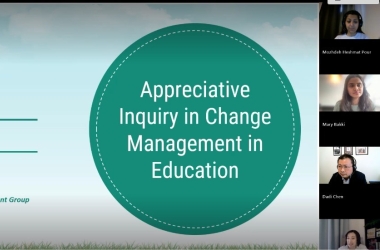
Earlier in 2026, Wittenborg students joined Andreea Nicolau online for a workshop on 'Appreciative Inquiry in Change Management of Higher Education'. Nicolau, a lecturer, executive coach and guest researcher at Eindhoven University of Technology, guided participants through a strengths-based approach to organisational change, emphasising how asking the right questions can transform both leadership and institutional practice.
The session began with students reflecting on moments of pride at Wittenborg, identifying the practices, environments, and support that contributed to these successes. Nicolau explained the core of Appreciative Inquiry:
“It’s about looking at what brings energy, what gives life, and building on that. We shift from asking what is wrong to asking what is best, and how we can create more of it.”
Students then moved into the dream phase, imagining Wittenborg as a leading hub for AI innovation, professional development, and global collaboration. Here, participants explored how ideas could complement each other and co-create a shared vision for the institution.
Dadi Chen, Deputy Head of the School of Business, highlighted the potential for student-led initiatives:
“We could encourage students to develop something, especially with AI software technology. Even starting projects online is amazing, and we should facilitate students in doing so.”
Chen added that practical steps could be taken over time: “Short-term actions like project weeks could lead to mid-term networks and longer-term student incubators, creating a sustainable culture of innovation.”
During the design and destiny phases, students identified initiatives to implement and sustain these ideas, such as pilot projects with companies, AI-integrated learning experiences, and collaborative student business incubators. Nicolau stressed the difference between Appreciative Inquiry and traditional problem-solving approaches:
“You first identify obstacles, then redefine them as opportunities to achieve excellence rather than just fixing problems. This approach moves from normality to exceptional outcomes.”
She also emphasised the importance of co-creation and reflection:
“When different perspectives and dreams come together, they can create a bigger and more inspiring vision for the organisation. It is through these collective insights that meaningful change emerges.”
The workshop showcased how Appreciative Inquiry can shift focus from deficits to possibilities, helping students identify actionable strategies for leadership, organisational growth, and AI-driven innovation.
WUP 11/03/2025
by Erene Roux
©WUAS Press
Tags
#SDG4: Quality Education
#Internationalisation
#Diversity
#Ethics
#internationalstudent
#studyinholland
395 words